.png?width=200&height=66&name=logo%20(1).png "HomesAlive Pets Canada")

Your dog's digestive system is a hub of activity and a major junction in their body. It's a long journey through the entire gastrointestinal tract, and each stop plays a critical role in your dog's health.
Caring for your dog's digestive system may seem complicated, but this blog will break down the digestion process and give you a better understanding of how to care for your dog's digestive needs.
A Quick Tour of Your Dog's Digestive Tract
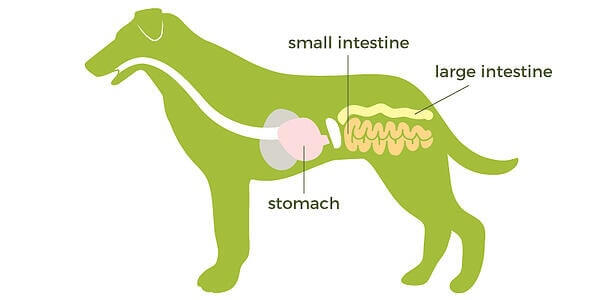
Let's take a look at the full digestion process from start to finish. Knowing where each critical point of digestion is and how it works may help you understand how to improve your dog's gastrointestinal health.
Mouth and Teeth
Your dog's mouth is the first stop of the digestive train. Chewing and saliva help to break down food into a smaller, more easily digestible format. Their sharp molars cut food vertically, like scissors, instead of the flat molars that we use to grind our food.
Dogs are anatomically designed to tear flesh and swallow large pieces of meat at a time. This is evident in their wide-set jaws and large esophagus.
Feeding raw dog food caters to their ancestral dietary needs, but the most popular food formats for domesticated dogs are kibble and other cooked foods. Dogs are capable of digesting these food formats, but they often take longer to break down and require proper chewing to ensure digestibility.
Did You Know?
Caring for your dog's teeth is an important part of caring for their digestion. Poor dental health can encourage bad eating habits. Their mouth can be a breeding ground for bacteria to flourish if you are not properly caring for their teeth.
Make sure that you have a solid pet dental care routine in place to prevent issues down the road.
Esophagus and Stomach
Once your dog has chewed and swallowed his food, it travels down the esophagus to their stomach. The muscle around the esophagus contracts and releases to push food down the esophageal shaft.
Your dog's stomach sits mostly on the left side of their body, tucked up under the ribcage just behind the last rib, meaning it's protected by bone rather than sitting out in the open as the intestines do.
Your dog's stomach is a very acidic environment that is necessary for breaking the food down to a substance called chyme.
Chyme is a gooey mixture of food, water, and stomach acids. This form allows the food to travel to the next stage of digestion where nutrients can be separated and absorbed.
Did You Know?
The extremely acidic environment of their stomach eliminates much more bacteria than our stomachs do. This allows them to safely consume raw meat and bones.
In healthy dogs, nominal amounts of bacteria that are typically found in raw meat are unlikely to cause any adverse effects. The risk is higher in dogs with compromised immune systems or if there is a large number of bacteria present in the food.
The Intestinal Tract
Now that the food has been turned into chyme, it will pass through the powerhouse of digestion, the intestines. Each stage of the intestinal tract works to break down food into its smallest forms, prevent bacterial colonization, and deliver energy and nutrients to the rest of the body.
Did You Know?
70% of your dog's immune system is located in their digestive tract, more specifically their intestines. This is why some digestive issues can present as a skin reaction similar to what you might see in food allergies or intolerances.
In reality, these reactions are more likely a result of poor digestion.
When the immune system doesn't recognize a nutrient, it is treated as a foreign body. Defences go up, and the body tries to eliminate any threat, releasing inflammation to nearby cells.
Small Intestine
The small intestine is made up of three sections: the duodenum, jejunum, and ileum. In total, the small intestine is roughly 25% of the entire intestinal tract, and it plays a pivotal role in nutrient absorption and immunity.
The duodenum, the first section of the small intestine, has two distinct functions. It has glands that secrete mucus, which neutralizes the intense stomach acids in the chyme.
It is also connected to the pancreas, liver, and gallbladder, which secrete enzymes and bile that further break down food into smaller components. The bile duct passes bile from the liver to the gallbladder and intestines, which aids in fat digestion into its fatty acid components.
The pancreas is responsible for secreting digestive enzymes like amylase, protease, and lipase. These enzymes are designed to break down carbohydrates, proteins, and fats, respectively.
Next, the food passes through the jejunum and ileum, which are responsible for absorption and immunity. The intestines are lined with small, finger-like protrusions called villi, which are covered in even smaller "fingers," called microvilli.
The microvilli are fine hair-like projections that absorb nutrients through the intestinal lining to the bloodstream, organs, and lymphatic system.
At this stage, nutrients are filtered to their appropriate destinations and checked by the immune system via the lymph nodes to prevent bacteria, pathogens, and poorly digested nutrients from harming your dog.
Did You Know?
Inflammation in the bile duct can severely compromise digestion and liver function and other organs, as well as result in a decrease in blood flow in those areas. Bile duct obstructions are rare, but chances are increased by other digestive system diseases.
Common illnesses that can cause or exacerbate a bile duct obstruction include pancreatitis, gastroenteritis, and liver disease.
Symptoms of these diseases can include loss of appetite, vomiting, and diarrhea. If you see any of these symptoms in your pet, contact your veterinarian immediately. They can diagnose your pet and prescribe antibiotics to prevent infection during the healing process.
Large Intestine
Also made up of 3 sections: the cecum, colon, and rectum. The large intestine deals with the digestion of dietary fibres and absorption of water from what will be the final waste product.
Once it reaches the large intestine, dietary fibre acts as a bulking agent to bind and drag out toxins and bacteria, as well as to apply pressure to the anal sacs, releasing even more bacteria as the waste is excreted.
Your dog's stool is made up of indigestible fibres, water, and the by-product of digested foods. This waste cycle can also eliminate nitrogen, which is produced during protein digestion, and bacteria in the food that weren't eliminated during digestion.
During digestion, the acids and enzymes can't kill all bacteria, but bile and digestive juices can prevent them from colonizing the digestive system. Many pathogens, like Salmonella and E. coli, are naturally excreted with the stool.

Common Digestive Issues and Problems in Dogs
A dog's digestive tract runs through a lot of moving parts, so it's not surprising that digestive issues are one of the most common reasons pet parents end up at the vet. A few of the most frequent digestive problems and diseases in dogs include:
-
- Bloat (GDV): a life-threatening emergency where the stomach fills with gas and can twist on itself. Large, deep-chested breeds are most at risk.
- Pancreatitis: inflammation of the pancreas, often triggered by a sudden change in diet or a high-fat meal, that interrupts normal enzyme production.
- Inflammatory bowel disease (IBD): chronic inflammation of the intestinal lining that can cause ongoing vomiting, diarrhea, or weight loss.
- Food intolerances and sensitivities: when the digestive system reacts poorly to a specific ingredient, often showing up as loose stool, gas, or skin irritation.
- Intestinal parasites: worms or protozoa that interfere with nutrient absorption and can cause diarrhea or a dull coat.
None of these conditions should be diagnosed at home. If your dog is showing ongoing digestive symptoms, a vet visit is always the right first step.
For a closer look at symptoms, causes, and what to do about each of these, check out our 5 Common Digestive Problems in Dogs and How to Help guide. If your dog has an especially sensitive stomach, Best Dog Food for Sensitive Stomach walks through diet adjustments that can help.

Caring for Your Dog's Digestive Health
While your dog's digestive system is designed to handle a lot, it does require some intervention on your part. What you put in makes a huge difference in how effectively this system runs.
Dogs are designed to eat fresh, minimally processed foods, so feeding an unnatural diet can limit the efficiency of the whole system and have lasting effects on the rest of the body.
Kibble, being the most convenient, cost-effective, and widely available food format for dogs, is very popular, but not every kibble diet is suited to how their bodies process food. Carb-heavy, artificial foods that use high-temperature cooking processes can leave nutrients from food altered and difficult to digest, leading to poor nutrient absorption and digestive issues.
In addition, dry food can lead to dehydration. Whether you are feeding a dog or cat, or a human for that matter, moisture plays a large part in the digestive process. Feeding wet food can drastically improve digestion.
Choose the Right Ingredients
When choosing a food for your dog, look for natural, real food ingredients over synthetic additives. When possible, feed as many fresh ingredients as you can. Fresh vegetables and fruits contain essential vitamins and minerals that are easy to digest and absorb.
Raw, minimally processed foods provide complete and natural nutrition, as well as a variety of health benefits. Even if you aren't feeding a raw diet, incorporating fresh food will improve digestion and contribute to overall health.
Did You Know?
Fruits and vegetables have an outer layer called cellulose. This layer is indigestible to dogs, so removing the cellulose by grinding or mashing the produce will make it easier for your dog to digest.
Be Cautious With Kibble
Dogs have adapted to digesting extruded kibble and cooked diets, but they simply don't hold a candle to a fresh, minimally processed diet. Many processed foods are subjected to high heat, killing many of the much-needed enzymes, bacteria, and nutrients that your pet needs.
Foods that rely too heavily on carbohydrate sources for proteins and minerals may not be providing your dog with everything that they need to thrive. In fact, they may be providing too much of some less desirable nutrients, like sugars.
Simple carbohydrates like corn, wheat, and even potatoes can affect blood sugar and feed bacteria that contribute to digestive issues in dogs. A little bit is fine, but some commercially produced dog foods overuse these ingredients.
Instead, look for complex carbohydrates that provide vitamins, minerals and dietary fibre in place of those that only provide cheap energy sources. Feeding your dog carbs is perfectly healthy as long as they are whole, healthy, and in appropriate quantities.
Canine diets should also be rich in protein and fat to get optimal sources of essential fatty acids, amino acids, and energy. This will support all the systems of the body, help to build and maintain muscle mass, and improve the efficiency of their digestive system.
Of course, fresh is still best, but if you are feeding a cooked diet, make sure that the animal products come from a named meat or meat meal. Avoid by-products, with the exception of organ meat, and "mystery" meats and vague wording, like "meat meal."
Gut Flora
Your dog's gastrointestinal tract is full of bacteria, but don't worry, there is such a thing as good bacteria. This type of bacteria aids in digestion and is always present.
Dogs with poor digestion are typically lacking either the number of bacteria needed to support the system, or their diet is not providing food for the bacteria to continue to populate.
Two things work together to keep that bacterial population healthy:
- Probiotics: Healthy bacteria work in conjunction with the digestive enzymes provided by the pancreas to break down food. It can be beneficial to add a probiotic supplement to your dog's diet to increase the population of good bacteria and support digestion.
- Prebiotics: Fermentable fibres called prebiotics are a food source for healthy gut bacteria. Look for fructooligosaccharides (FOS), chicory root, or inulin in the ingredient list to find out if your dog's food has this valuable fibre source — foods like barley, oats, and beet pulp all contain prebiotics to aid digestion.
You will often see a modest amount of pre- and probiotics added to commercial pet foods to support digestion, but some dogs can benefit from additional supplementation.
We cover our top picks for every budget in Best Prebiotics, Probiotics, and Digestive Enzymes for Dogs, including options for supporting dogs with more serious conditions like Diabetes Mellitus, which is often accompanied by poor digestion and unbalanced gut flora.
Food Fuels Life
Whether your dog is suffering from digestive issues or you are just acting preventatively, digestion is the center of whole-body health. The right diet can maintain healthy digestion and help to relieve symptoms of poor digestion.
Now that you understand how your dog breaks down food, it's time to take a good look at what you are feeding them. Can some digestive issues be attributed to diet? Are you giving your dog everything they need to thrive?
Many aspects of their health are connected to how they digest their food. It's never too late to try new things. Start by adding some fresh ingredients, switching to a higher-quality diet, or adding digestive aids to your pup's food. You'll be pleasantly surprised by the results.
Dog Digestive System FAQs
What is a dog's digestive tract?
A dog's digestive tract (also called the GI tract or GI system) is the full pathway food travels through their body. It starts in the mouth, then passes through the esophagus, stomach, small intestine, and large intestine. It also connects to other organs like the pancreas, liver, and gallbladder that help break food down along the way.
Where is a dog's stomach located?
A dog's stomach sits on the left side of their abdomen, tucked under the ribcage just behind the last rib, where it's protected from everyday bumps and impacts.
How long does it take my dog to digest food?
Digestion typically takes somewhere between 8 and 24 hours depending on the dog and the food. Different types of food will breakdown different, like wet vs raw vs dry meals. Your dog's overall health can be a factor as well.
What are the most common digestive issues in dogs?
Bloat, pancreatitis, inflammatory bowel disease, food intolerances, and intestinal parasites are among the most common. See our 5 Common Digestive Problems in Dogs and How to Help guide for a full breakdown of symptoms and next steps.
How can I support my dog's digestive system?
Feed fresh, minimally processed ingredients where you can, keep an eye on hydration (especially with dry kibble), stick to named meat sources, and consider a pre/probiotic if your dog's digestion needs extra support. Any sudden or ongoing changes are worth a call to your vet.
.jpg)